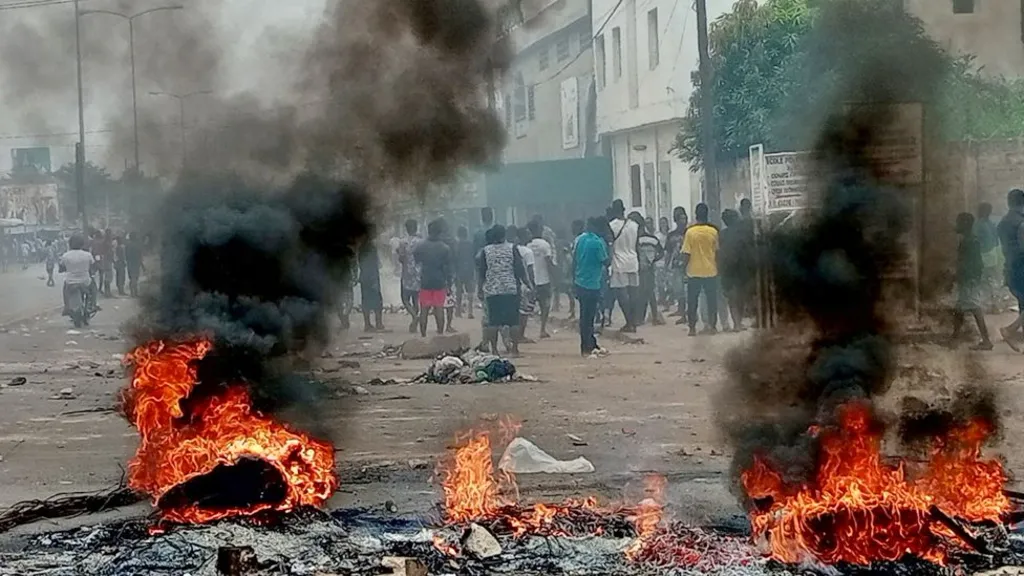
A new constitution that has allowed Togo's long-time head of state Faure Gnassingbé to shift to a new role as all-powerful prime minister – and escape the constraint of presidential term limits – has triggered anger on the streets of the capital, Lomé. Protests are set to continue this Friday.
At least five demonstrators have died while confronting official security forces in recent weeks.
But it is not the orthodox political opposition – predictably crushed in local elections last week – that has mobilised frustrated young Togolese people.
Instead it is musicians, bloggers and activists who have tapped into popular anger and weariness with a regime that has been in power – under the leadership of Faure Gnassingbé or, before him – his father Gnassingbé Éyadéma, for almost six decades.
That outstrips even Cameroon's 92-year old President Paul Biya - who has just confirmed his intention to stand for an eighth successive term in elections later this year – or Gabon's father-and-son presidents, Omar Bongo and Ali Bongo, latter of whom was deposed in a coup in August 2023.
 AFP/Getty Images
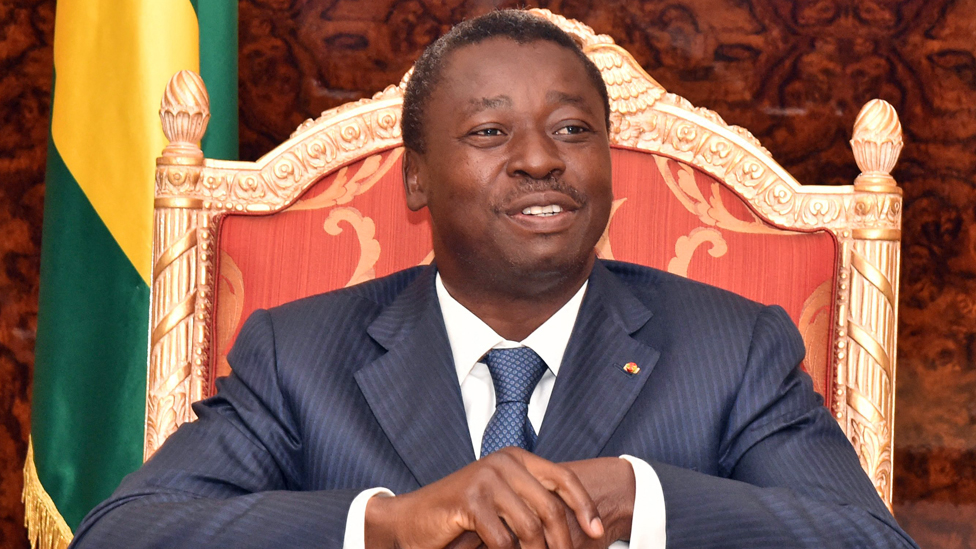
Faure Gnassingbé, a shrewd and often discreet operator… will no longer need to stand for re-election in his own name"
Analyst Paul Melly
The lessons of that episode did not escape Faure Gnassingbé, a shrewd and often discreet operator who quickly moved to devise a new constitutional structure for Togo, to prolong his own hold on power while playing down his personal profile, in a bid to defuse accusations of dynastic rule.
He will no longer need to stand for re-election in his own name.
The 59-year-old holds the premiership because his Union pour la République (Unir) party dominates the national assembly - and will continue to do so for the foreseeable future, thanks to a constituency map gerrymandered to over-represent its northern heartlands and understate the voting weight of the pro-opposition coastal south.
Gilbert Bawara, Togo's civil service and labour minister, maintains the 2024 election was above board, with "all the major political actors and parties" taking part.
"The government cannot be held responsible for the weakness of the opposition," Bawara told BBC Focus on Africa TV last week.
He added that those with a genuine reason to demonstrate could do so within the law, blaming activists abroad for inciting "young people to attack security forces" in an attempt to destabilise the country.
The new constitutional framework was announced at short notice in early 2024 and quickly approved by the compliant government-dominated national assembly. There was no attempt to secure general public approval through a referendum.
A one-year transition concluded this May as Gnassingbé – who had been head of state since 2005 – gave up the presidency and was installed in the premiership, a post now strengthened to hold all executive power and total authority over the armed forces.
To occupy the presidency, a role now reduced to a purely ceremonial function, legislators chose the 86-year old former business minister, Jean-Lucien Savi de Tové.
 Anadolu/Getty Images
Togo is one of the poorest countries in the world and has been governed by the Gnassingbé family for almost 60 years
This reshuffling of the power structure was presented abroad by regime mouthpieces as moving from a strong presidential system to a supposedly more democratic "parliamentary" model – in tune with the traditions of the Commonwealth, which Togo, like Gabon, had joined in 2022, to broaden its international connections and reduce reliance on traditional francophone links with France, the former colonial ruler.
The transition to new constitutional arrangements designed to perpetuate Gnassingbé's rule passed off almost without outside comment from international partners whose attention is currently focussed on Gaza and Ukraine rather than Africa.
Nor was there any complaint from fellow leaders in the Economic Community of West African States (Ecowas), even after Togo held fresh legislative elections just weeks after the new constitution had been promulgated, in flagrant breach of the regional bloc's protocol on good governance and democracy, which says that after a change of constitution at least six months must elapse before any major election is held.
Badly shaken by the decision of three military-run countries - Burkina Faso, Mali and Niger - to quit Ecowas, remaining member governments are reluctant to challenge the behaviour of others in case they follow suit.
But on the streets of Lomé it has been a different matter.
The rapper and regime critic Essowe Tchalla, known by his stage name "Aamron", released a satirical video calling for the "celebration" of Gnassingbé's 6 June birthday.
When he was arbitrarily snatched from his home at the end of May by regime security agents and taken to an unknown location, anger surged among young urban Togolese.