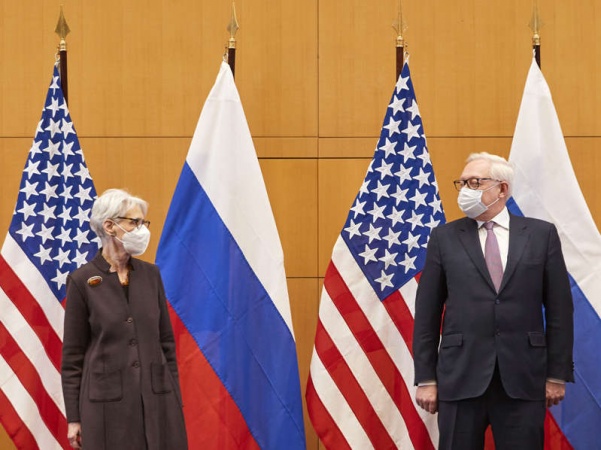
Provided by Associated PressUS Deputy Secretary of State Wendy Sherman, left, and Russian deputy foreign minister Sergei Ryabkov attend security
Russia on Thursday sharply raised the stakes in a showdown with the West over Ukraine, with a top diplomat saying he wouldn't exclude a Russian military deployment to Cuba and Venezuela if tensions with the United States mount.
Deputy Foreign Minister Sergei Ryabkov, who led the Russian delegation in Monday’s talks with the United States in Geneva, said in televised remarks that he would neither confirm nor exclude the possibility that Russia could send military assets to Cuba and Venezuela.
The negotiations in Geneva and Wednesday’s NATO-Russia meeting in Vienna failed to narrow the gap on Moscow’s security demands amid a buildup of Russian troops near Ukraine. While Moscow demanded a halt to NATO expansion, Washington and its allies firmly rejected them as a nonstarter.
Speaking in an interview with Russian RTVI TV broadcast, Ryabkov noted that “it all depends on the action by our U.S. counterparts,” adding that President Vladimir Putin has warned that Russia could take military-technical measures if the U.S. provokes Moscow and turns up military pressure on it.
![FILE - Russian Deputy Foreign Minister and head of delegation Sergei Ryabkov attends a Treaty on the Non-Proliferation of Nuclear Weapons (NPT) conference in Beijing, China, Jan. 30, 2019. Ryabkov, who heads the Russian delegation at the security talks, described the demand for guarantees precluding NATO's expansion to Ukraine and other ex-Soviet nations as]() © Provided by Associated Press FILE - Russian Deputy Foreign Minister and head of delegation Sergei Ryabkov attends a Treaty on the Non-Proliferation of Nuclear Weapons (NPT) conference in Beijing, China, Jan. 30, 2019. Ryabkov, who heads the Russian delegation at the security talks, described the demand for guarantees precluding NATO's expansion to Ukraine and other ex-Soviet nations as "absolutely essential" and warned that the U.S. refusal to discuss it would make further talks senseless. (Thomas Peter/Pool Photo via AP, File)
© Provided by Associated Press FILE - Russian Deputy Foreign Minister and head of delegation Sergei Ryabkov attends a Treaty on the Non-Proliferation of Nuclear Weapons (NPT) conference in Beijing, China, Jan. 30, 2019. Ryabkov, who heads the Russian delegation at the security talks, described the demand for guarantees precluding NATO's expansion to Ukraine and other ex-Soviet nations as "absolutely essential" and warned that the U.S. refusal to discuss it would make further talks senseless. (Thomas Peter/Pool Photo via AP, File)
Ryabkov said a refusal by the U.S. and its allies to consider the key Russian demand for guarantees against the alliance’s expansion to Ukraine and other ex-Soviet nations raises doubts about continuing the talks.
Kremlin spokesman Dmitry Peskov noted “some positive elements and nuances” during the talks, but described them as “unscuccessful” because of stark disagreements on Russia’s key demands.
“The talks were initiated to receive specific answers to concrete principal issues that were raised, and disagreements remained on those principal issues, which is bad,” he said in a conference call with reporters.
![Russian deputy Foreign Minister Sergei Ryabkov arrives for security talks with US Deputy Secretary of State Wendy Sherman at the United States Mission in Geneva, Switzerland, on Monday, Jan. 10, 2022. (Denis Balibouse/Pool via AP)]() © Provided by Associated Press Russian deputy Foreign Minister Sergei Ryabkov arrives for security talks with US Deputy Secretary of State Wendy Sherman at the United States Mission in Geneva, Switzerland, on Monday, Jan. 10, 2022. (Denis Balibouse/Pool via AP)
© Provided by Associated Press Russian deputy Foreign Minister Sergei Ryabkov arrives for security talks with US Deputy Secretary of State Wendy Sherman at the United States Mission in Geneva, Switzerland, on Monday, Jan. 10, 2022. (Denis Balibouse/Pool via AP)
Peskov warned of a complete rupture U.S.-Russian relations if proposed sanctions targeting Russian President Vladimir Putin and other top civilian and military leaders are adopted. The measures, proposed by Senate Democrats, would also target leading leading Russian financial institutions if Moscow sends troops into Ukraine.
Peskov criticized the proposals as an attempt to up the pressure on Moscow during the talks, saying it wouldn't work.
“It concerns sanctions, which taking into account the inevitable adequate response, effectively amount to an initiative to rupture relations,” he warned, adding that Russian will respond in kind to protect its interests.
![From left, United States Deputy Secretary of State Wendy Sherman, NATO Secretary General Jens Stoltenberg, Russia's Deputy Foreign Minister Alexander Grushko, and Russia's Deputy Defense Minister Alexander Fomin pose for a photo prior to the NATO-Russia Council at NATO headquarters, in Brussels, Wednesday, Jan. 12, 2022. Senior NATO and Russian officials are meeting Wednesday to try to bridge seemingly irreconcilable differences over the future of Ukraine, amid deep skepticism that Russian President Vladimir Putin's security proposals for easing tensions are genuine. (Olivier Hoslet, Pool Photo via AP)]() © Provided by Associated Press From left, United States Deputy Secretary of State Wendy Sherman, NATO Secretary General Jens Stoltenberg, Russia's Deputy Foreign Minister Alexander Grushko, and Russia's Deputy Defense Minister Alexander Fomin pose for a photo prior to the NATO-Russia Council at NATO headquarters, in Brussels, Wednesday, Jan. 12, 2022. Senior NATO and Russian officials are meeting Wednesday to try to bridge seemingly irreconcilable differences over the future of Ukraine, amid deep skepticism that Russian President Vladimir Putin's security proposals for easing tensions are genuine. (Olivier Hoslet, Pool Photo via AP)
© Provided by Associated Press From left, United States Deputy Secretary of State Wendy Sherman, NATO Secretary General Jens Stoltenberg, Russia's Deputy Foreign Minister Alexander Grushko, and Russia's Deputy Defense Minister Alexander Fomin pose for a photo prior to the NATO-Russia Council at NATO headquarters, in Brussels, Wednesday, Jan. 12, 2022. Senior NATO and Russian officials are meeting Wednesday to try to bridge seemingly irreconcilable differences over the future of Ukraine, amid deep skepticism that Russian President Vladimir Putin's security proposals for easing tensions are genuine. (Olivier Hoslet, Pool Photo via AP)
The talks come as an estimated 100,000 combat-ready Russian troops, tanks and heavy military equipment are massed near Ukraine’s eastern border. The buildup has caused deep concerns in Kyiv and the West that Moscow is preparing for an invasion. Russia denies that it's pondering an invasion and in turn accuses the West of threatening its security by positioning military personnel and equipment in Central and Eastern Europe.
Peskov rebuffed the West's calls for Russia to help deescalate tensions by pulling back troops from areas near Ukraine, noting that the country is free to move them wherever it deems necessary on its own territory.
“It's hardly possible for NATO to dictate to us where we should move our armed forces on the Russian territory,” he said.
Peskov underscored that Russia is ready to continue the talks but wants them to produce results. “There will be no deficit of a political will to continue the negotiations,” he said.
Tensions revolving around Ukraine and Russia's demands on the West again appeared on the table at Thursday's meeting of the Organization for Security and Cooperation in Vienna.
![NATO Secretary General Jens Stoltenberg, right, welcomes Russia's Deputy Foreign Minister Alexander Grushko, center, and Russia's Deputy Defense Minister Alexander Fomin prior to the NATO-Russia Council at NATO headquarters, in Brussels, Wednesday, Jan. 12, 2022. Senior NATO and Russian officials are meeting Wednesday to try to bridge seemingly irreconcilable differences over the future of Ukraine, amid deep skepticism that Russian President Vladimir Putin's security proposals for easing tensions are genuine. (Olivier Hoslet, Pool Photo via AP)]() © Provided by Associated Press NATO Secretary General Jens Stoltenberg, right, welcomes Russia's Deputy Foreign Minister Alexander Grushko, center, and Russia's Deputy Defense Minister Alexander Fomin prior to the NATO-Russia Council at NATO headquarters, in Brussels, Wednesday, Jan. 12, 2022. Senior NATO and Russian officials are meeting Wednesday to try to bridge seemingly irreconcilable differences over the future of Ukraine, amid deep skepticism that Russian President Vladimir Putin's security proposals for easing tensions are genuine. (Olivier Hoslet, Pool Photo via AP)
© Provided by Associated Press NATO Secretary General Jens Stoltenberg, right, welcomes Russia's Deputy Foreign Minister Alexander Grushko, center, and Russia's Deputy Defense Minister Alexander Fomin prior to the NATO-Russia Council at NATO headquarters, in Brussels, Wednesday, Jan. 12, 2022. Senior NATO and Russian officials are meeting Wednesday to try to bridge seemingly irreconcilable differences over the future of Ukraine, amid deep skepticism that Russian President Vladimir Putin's security proposals for easing tensions are genuine. (Olivier Hoslet, Pool Photo via AP)
Polish Foreign Minister Zbigniew Rau, who assumed the position of the OSCE Chairman-in-Office, noted in his opening speech that "the risk of war in the OSCE area is now greater than ever before in the last 30 years.”
“For several weeks, we have been faced with the possibility of a major military escalation in Eastern Europe," he said. “We have recently heard a demand for security guarantees related to an important part of the OSCE area and the renewed discourse about spheres of influence. All these aspects require a serious international assessment and a proper reaction.”
Rau emphasized the need to “focus on a peaceful resolution of a conflict in and around Ukraine ... in full respect of the sovereignty, territorial integrity and unity of Ukraine within its internationally recognized borders."
In 2014, Russia annexed Ukraine’s Crimean Peninsula after the ouster of its Moscow-friendly leader and threw its weight behind a separatist insurgency in the country’s east, where more than seven years of fighting has killed over 14,000 people.
A 2015 peace deal brokered by France and Germany has helped end large-scale battles, but frequent skirmishes have continued and efforts to negotiate a political settlement have failed.