
ADVERTISEMENT


Updating your news feed...

NaYourNews is an online news aggregating website where only fact checked stories are published.
Copyright NaYourNews2026
Updating your news feed...
NaYourNews is an online news aggregating website where only fact checked stories are published.




%26format%3Dwebp&w=256&q=75)
%26format%3Dwebp&w=256&q=75)



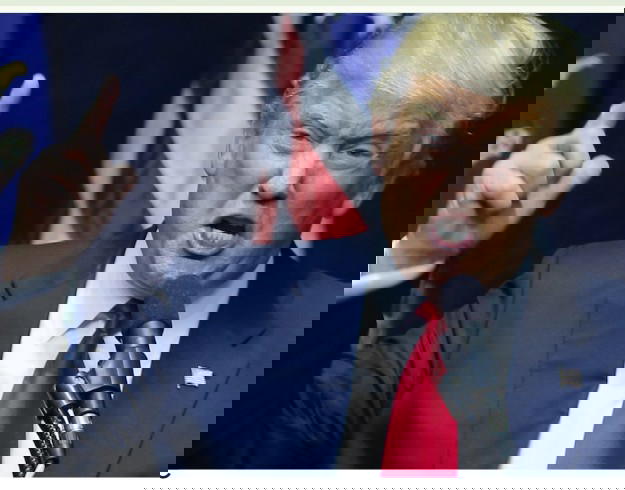

Photo: GT
China on Sunday published a white paper outlining its detailed steps and measures in fighting the COVID-19 epidemic, which serves as a demonstration to the world on how China won the arduous fight.
It also shows how China has timely and effectively curbed the viral spread, bearing no procrastination, delivering a strong rebuke to foreign media and politicians' rancorous accusations of China on alleged "cover-up" and "delay" in its response.
The 37,000-word White Paper on fighting COVID-19: China in Action, containing four chapters, was issued to record the Chinese people's battle against the virus, share with the international community China's experience in curbing the virus, and clarify China's stance in fighting the virus.
As of May 31, China reported a total of 83,017 confirmed COVID-19 patients, among which 78,307 were discharged from hospital with 4,634 deaths, which makes the country's mortality rate 5.6 percent and a cure rate of 94.3 percent, read a white paper issued by the State Council Information Office on Sunday.
On Thursday, China's hardest-hit Hubei Province accomplished seven "zeros": zero new COVID-19 cases, zero new suspected cases, zero new deaths, zero silent carriers, zero imported cases, zero existing confirmed cases and zero existing suspected cases, the provincial health official said.
The whole country was alerted and actively participated in the viral battle, which included a historical lockdown of 60 million people in Hubei Province, the region hit hardest by the virus; and 1.4 billion people voluntarily protecting themselves by cooperating with the government's viral prevention measures, Wang Guangfa, a respiratory expert at Peking University First Hospital, told the Global Times.
"This is why China was able to contain the virus within five months," Wang said.
The publication of the white paper, will also act as China's rebuttal to foreign media, such as the Associated Press, Wall Street Journal and BBC, along with foreign politicians, including US President Donald Trump and US Secretary of State Mike Pompeo's reckless accusations that China has been covering up the viral spread and slowing the response so that the virus could ravage the rest of the world.
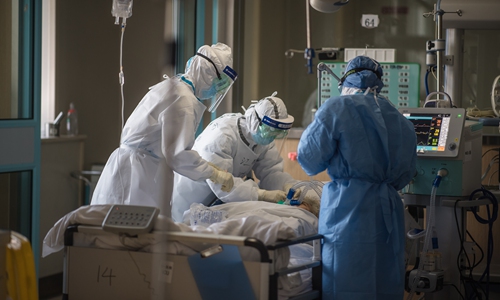
Medical staff members from Jiangsu Province work at an ICU ward of the Wuhan No. 1 Hospital in Wuhan. (Xinhua/Xiao Yijiu)
Timely information-sharing
Ever since infection cases nosedived in China, whilst the number skyrocketed in other countries, especially in the US, foreign media and politicians have been passing the buck to China. A latest rumor that stirred public opinion was an article from the Associated Press, which said China's delay in information sharing irked the WHO.
China did not conceal any information about the coronavirus, as some Western media have claimed, Ma Xiaowei, head of the National Health Commission said at the conference launching the white paper on Sunday. It gave the international community the relevant information at the first opportunity and made significant contributions to the global prevention of the virus. China identified the genome sequence in just eight days and developed a testing kit in 16 days, according to Ma.
China notified the WHO about the outbreak updates on January 5, one day after it warned the US, and it shared the preliminary research of the virus' etiology to the WHO on January 9. Ever since January 11, China has kept notifying the WHO on a daily basis, and on January 12, China shared with the WHO about information on the genome sequence of the novel coronavirus.
China's Vice Foreign Minister Ma Zhaoxu shrugged off the idea that COVID-19 has caused China's relations with the rest of the world to worsen, saying that on the contrary, mutual assistance and the sharing of experience during the pandemic between China and the rest of the world have made relations closer.
He said China has dispatched 29 medical expert teams to 27 countries and regions to help them fight the virus, and is now providing virus control assistance to 150 countries and four international organizations.
China has translated its treatment methodology of coronavirus into three languages, distributed it to 180 countries and regions; and Chinese doctors have conducted constant exchanges with their international counterparts, according to the white paper.
Trump had initially praised China's effective and transparent manner in dealing with the virus, but his attitude and that of other US politicians suddenly changed after the US was ravaged by COVID-19. They launched a full-scale campaign to blame China, from instigating a probe to the virus' origin to slandering China for alleged cover-up and delayed response. Currently, the US has recorded more infections and deaths than any other country in the world.
Ma Zhaoxu said certain countries are going against historical trends, throwing mud at China for their own failure in controlling the virus, and fabricating and disseminating a political virus. Faced with such wrongdoing, China will staunchly fight back, he said.
"They believed they would be fine by cutting all possible connections with China and rest easy, but the US had missed the golden window of opportunity which had cost China a lot to fight for, and procrastinated in their response to the virus," Li Haidong, a professor from the Institute of International Relations at the China Foreign Affairs University, told the Global Times.
According to the latest media reports, the US has recorded more than 1.8 million coronavirus cases, with recent increases seen in states such as Arizona, Florida and Mississippi. The resumption to economic and social activity, as well as widespread protests against police brutality, continue to raise concerns among some health officials of a further spread.
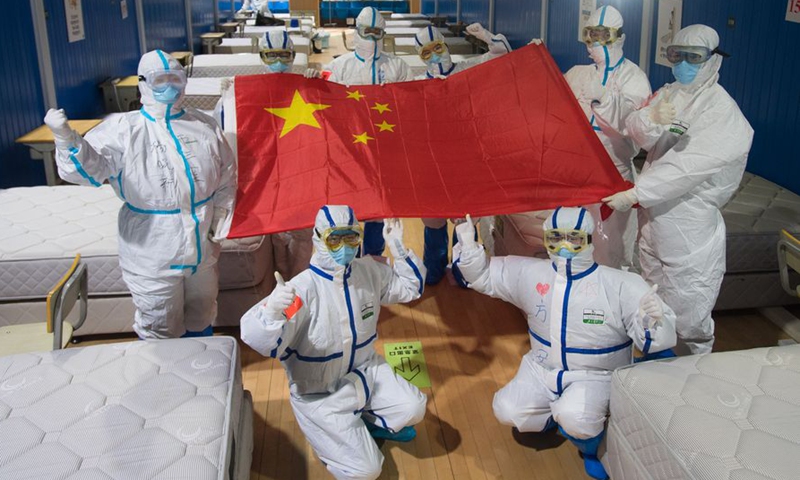
Medical workers pose for photos after seeing cured patients off at the Wuchang temporary hospital in Wuhan, central China's Hubei Province, March 10, 2020. (Xinhua/Xiao Yijiu)
Hard-won battle
On January 22, Chinese President Xi Jinping ordered the immediate imposition of tight restrictions on the movement of people and channels of exit in Hubei and Wuhan.
After the instruction was issued, 346 national medical teams and 42,600 medical workers had been dispatched to Hubei and Wuhan to help since January 24, which was dubbed as "the biggest medical aid operation since the establishment of the People's Republic of China; later on February 10, 19 other Chinese provinces and autonomous regions were assigned to help 16 other Hubei cities.
Through the efforts and solidarity of the whole nation, the rest of China, except Hubei, saw ten days of decline in new infections on February 14; on March 11, new local confirmed cases nationwide slowed to one digit numbers.
Hospitals in Wuhan received a total of over 9,600 cases in critical condition, and the cure rate increased from 14 percent to 89 percent; for those who suffered from underlying diseases, medical workers made specific plans for everyone, once there is hope, they never gave up, reads the white paper.
By comparison, a cohort published in May in The Lancet saying that of 257 critically ill New York City residents treated at two Manhattan hospitals, 39 percent died.
After Wuhan was sealed off in early April, China used only one incubation period to see new infections reach a tipping point, thanks to the Chinese people's cooperation with the government and providing assistance nationwide to help Wuhan and Hubei, said Wang.
China is willing to promote international cooperation and will make it a global public good, as the country previously promised, once the vaccine is successfully put onto the market, Wang Zhigang, the director of China's Ministry of Science and Technology, said at the press conference.
Five COVID-19 vaccines have so far been reportedly delivered into clinical trials in China. Some experts predicted that China may be the first country in the world to successfully achieve large scale production of a coronavirus vaccine.
Wang said he had talked to Bruce Aylward, a Canadian epidemiologist who led the WHO-China Joint Mission on COVID-19 in February while the latter was researching in Wuhan. "He and other WHO experts were holding an objective view but tinted with little suspicion regarding China before they came… Mr. Aylward asked if we deliberately showed him the well-equipped hospitals when we showed him the designated hospitals for COVID-19 patients in Wuhan. But we told him that those designated hospitals were newly-built and well-equipped."
Aylward said at a news conference in Geneva on Feb 26 that China had been investing massively on disease control and treatment that is even unreachable for Europe.
He stunned skeptics on China's resources to treat patients by saying he would want to be treated in China if he caught the virus.