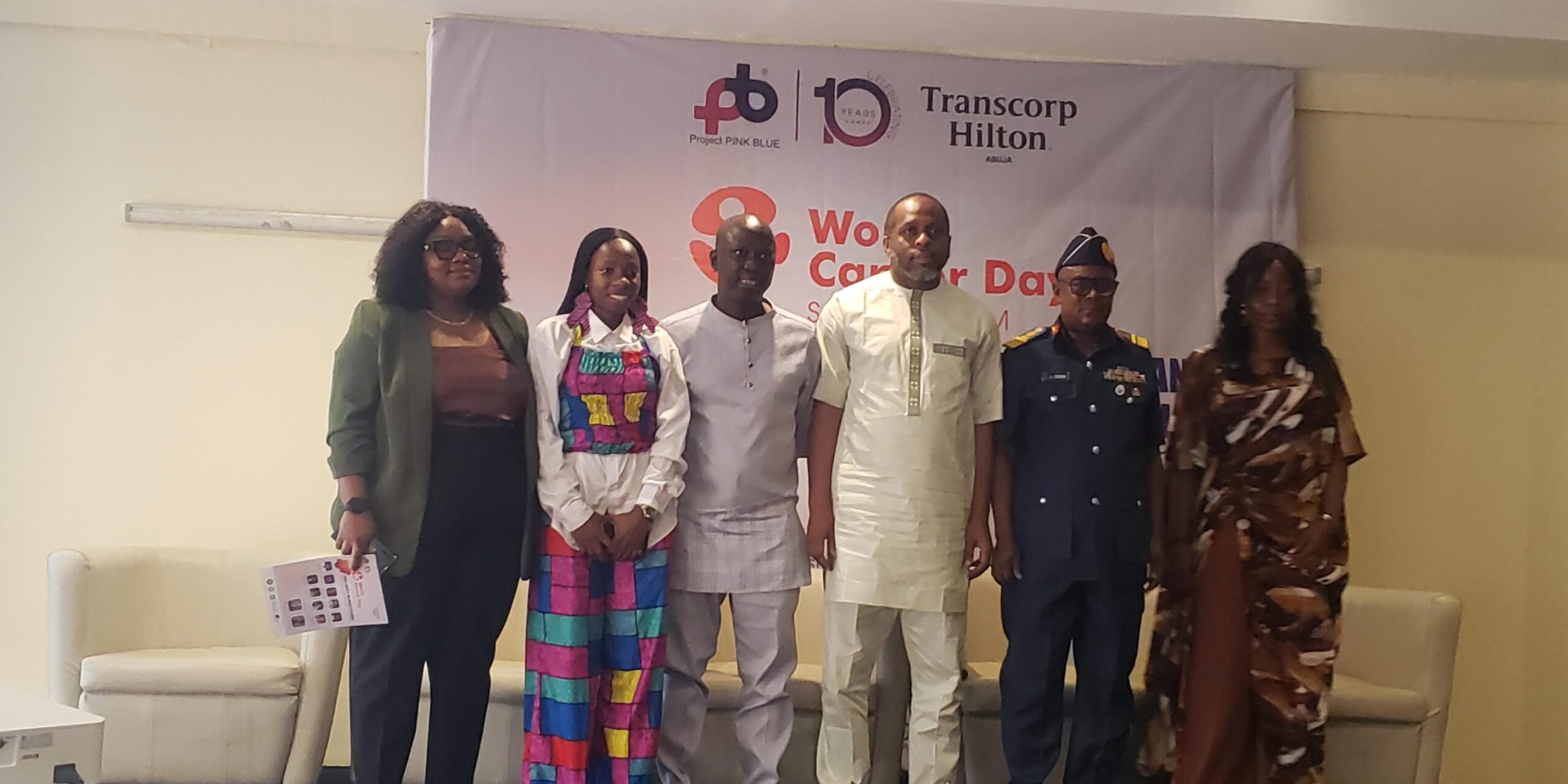
The event brought together government officials, military representatives, cancer survivors, and development partners who examined how insecurity and health system gaps are turning treatable cancer cases into terminal ones.
Stakeholders and health experts have warned that insecurity, weak healthcare infrastructure, and uneven access to treatment are worsening cancer outcomes in Nigeria, particularly for patients in conflict-prone and underserved communities.
They spoke at a World Cancer Day symposium organised by Project Pink Blue in Abuja, on Tuesday.
The symposium brought together health experts, government officials, military representatives, cancer survivors, and development partners who examined how insecurity and health system gaps are turning treatable cancer cases into terminal ones.
Opening the panel discussion themed “Cancer, Conflict & Insecurity in Nigeria: What can we do to ensure access to cancer care for vulnerable communities amid conflict and insecurity?”, the Publisher of PREMIUM TIMES, Dapo Olorunyomi, said effective cancer treatment depends on continuity of care.
Mr Olorunyomi, who was represented by the Managing Editor of PREMIUM TIMES, Idris Akinbajo, explained that regular chemotherapy cycles and radiotherapy schedules are essential, but they are often disrupted in insecure areas.
He noted that patients in high-risk camps or vulnerable communities often face a total collapse of the federal care chain, turning treatable cases into terminal ones.
He added that insecurity disrupts access to essential drugs and makes it difficult to deploy radiotherapy machines promised by the government.
He also suggested that the military’s logistics capacity and secure infrastructure in high-risk areas could be better leveraged to support healthcare delivery beyond emergency response.
‘Military assets could support cancer care’
In his response, Air Vice Marshal and Chief of Medical Services at the Nigerian Air Force, Ikechukwu Ogbodo, said the military already provides health services in conflict zones and could extend its logistics and infrastructure support to cancer care.
Mr Ogbodo explained that the Air Force has transported displaced persons, medical personnel, and equipment to and from conflict areas, and has maintained secure health facilities in locations such as Dalori and Bama in Borno State.
He added that the Air Force’s transport aircraft and helicopters, currently used for general healthcare and humanitarian missions, could be leveraged to support cancer patients through partnerships with civil society organisations.
“This infrastructure can be extended to those who have cancer, especially when we collaborate with organisations like Project Pink Blue in identifying patients who need these services,” he said.
He also noted that Air Force hospitals in secure locations such as Abuja and Lagos already provide some cancer-related services and could be better integrated into the National Oncology Network through collaboration and technical support.
A major concern
In his remarks, the President of the Nigerian Medical Association (NMA), Bala Audu, warned that insecurity and poor access to healthcare are worsening cancer outcomes in Nigeria.
Speaking from personal experience as a specialist who spent much of his medical career in Maiduguri, Mr Audu said Nigeria is confronting a “dual crisis” of a rising cancer burden and widespread insecurity, both of which are stretching the health system beyond its limits.
He said although cancer care remains weak even in stable settings, insecurity has made access to prevention, diagnosis and treatment nearly impossible in many rural and conflict-prone areas.
Mr Audu said Nigeria records about 127,000 new cancer cases each year, noting that more than half of affected patients die due to late diagnosis, high treatment costs and limited availability of services.
According to him, many Nigerians avoid screening even when they are aware of cancer risks, largely because of fear, denial and the belief that a cancer diagnosis is a death sentence.
“As a result, we mostly see advanced cases, and advanced cancers are often not curable,” he said.
Survivors recount barriers to care
Cancer survivor and patient navigator with Project Pink Blue, Mercy Soporuchi, described how insecurity and uneven access to the Cancer Health Fund (CHF) force patients to make life-threatening choices.
Ms Soporuchi explained that she relocated from Abia State to Abuja in 2023 to access the Fund, which is unavailable in many states.
She said many patients refuse referrals to specialised centres due to fear of kidnapping and unsafe roads.
“One patient told me she would rather die in her state than risk her life travelling to Zaria,” she added.
She also recalled cases where patients died because emergency care was unavailable in their home states.
“They came to Abuja for treatment and returned home, but when emergencies happened, before they could reach a hospital that could stabilise them, we lost them,” she said.
‘Cancer funding improving but still inadequate’
Speaking at the event, the director general of the National Institute for Cancer Research and Treatment (NICRAT), Usman Malami, said the Fund currently operates in six designated hospitals, one in each geopolitical zone, but is limited by funding and specialist availability.
Mr Malami, who was represented by the acting director of clinical services at NICRAT, Ali Gombe, said Nigeria had made some progress in cancer control, noting that cancer received a dedicated federal budget for the first time in 2024.
“There is now an agency with a dedicated budget for cancer control. In 2025 and 2026, the amount budgeted for cancer care has increased,” he said.
He, however, acknowledged longstanding gaps in cancer control, noting that NICRAT only became fully operational in 2023 following the appointment of its director-general.
Also speaking, Country Director of the Clinton Health Access Initiative, Olufunke Fasawe, said affordability remains the biggest obstacle to cancer care nationwide, even outside conflict zones.
Ms Fasawe described cancer in Nigeria as both a scarcity problem and an affordability crisis, while warning against screening without guaranteed access to treatment.
“There’s no point in screening if you will not treat what you find. If you screen, you must link people to care,” she said.
She called for sustainable financing models beyond the National Health Insurance Scheme and said the foundation is open to partnerships that strengthen access to care.