2022 Budget: Nigerian judiciary persists in budgetary secrecy as proposed spending hits all-time high
Ameh Ejekwonyilo
|
October 22nd, 2021
|
470 views
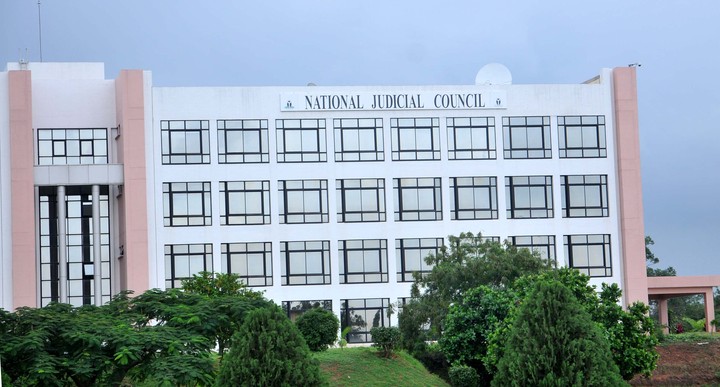
Legalnaija -National Judicial Council building used to illustrate the story
The Nigerian judiciary has proposed an all-time high spending estimate of N120 billion for 2022.
But as has been the case over the years, the breakdown of the proposed budget is hidden from the public, a development that detracts from the credibility of the arm of government expected to set high standards of transparency, accountability, and democratic ethos.
The proposed budgetary spending of N120 billion represents about nine per cent increase from the N110 billion that has remained the judiciary’s total vote for three consecutive years – 2019 to 2021.
The proposed allocation, if approved or further raised by the National Assembly currently scrutinising the total N16.39 trillion proposed by President Muhammadu Buhari earlier this month, will be a partial grant of the judiciary’s perennial clamour for more funding.
But Muiz Banire, a Senior Advocate of Nigeria (SAN), said the estimate for the judiciary “is a far cry from satisfying the needs of the judiciary.”
For several years, successive Chief Justices of Nigeria (CJNs) have lamented the poor funding of the judiciary.
In September 2013, then CJN, Aloma Mukhtar, during a new legal year ceremony, bemoaned the judiciary’s steady budgetary decline from N95 billion in 2010 to N67 billion in 2013.
Ex CJN, Aloma Mukhtar
Since 2014, however, the budget has managed to climb from N68 billion to N110 billion in 2019 and remained so in 2020 and 2021.
It implies that by 2021, if the budget is approved as presented, the judiciary’s budget would have only increased by N15 billion from what it was 12 years ago in 2010.
Advocates of more funding for the judiciary contrast its budget with that of the National Assembly.
This is despite that, in the 12 years period from 2010 to 2021, the National Assembly’s budget dropped from N154.2 billion to N134 billion.
Although the National Assembly’s budget slumped during the period, its estimates always dwarfed the judiciary’s in each of the 12 years.
Also, despite the judiciary being responsible for the salaries of all state and federal judges, in addition to the capital and recurrent expenditures of all the country’s federal courts and institutions, its budget declined from N95 billion in 2010 to N68 billion in 2014, the year the National Assembly got N150 billion.
While appearing before a House of Representatives committee to defend the judiciary’s 2021 budget, the Secretary of the National Judicial Council (NJC), Ahmed Saleh, appealed to the legislative and executive arms of government to increase budgetary allocations to the judiciary.
“The Supreme Court was expanded to 20, the Court of Appeal and Federal High Court is in the process of appointing 20 additional judges,” Mr Saleh had said.
There is a consensus among players in the Nigerian judiciary on the need for an increased budget for the third arm of government at both the state and federal levels.
Aside from this, the acute shortage of infrastructure resulting in most Nigerian judges still recording proceedings in long hands and sitting in dilapidated or unconducive courthouses across the country, including the federal capital, is evidence of years-long underfunding.
A recent revelation by the President of the Court of Appeal, Monica Dongban-Mensem, about how poorly Nigerian judges are paid while federal legislators continue to enjoy “jumbo allowances” which analysts say are much higher than what most of their counterparts around the world receive, is another testimony of how poor the funding the judiciary gets.
Budgetary secrecy
However, the calls for more allocations to the judiciary is not being complemented with an attitude of financial transparency and probity, many have said.
To some like Eze Onyekpere, a lawyer and fiscal accountability expert, poor budgetary allocation to the judiciary is not a justification for the lack of transparency and probity.
“The National Judicial Council (NJC) would also say, ‘we don’t have enough money to run our affairs,’ but what about the money they gave you? What are the details?” Mr Onyekpere said.
Interestingly, many who call for a substantial rise in the judiciary’s budget also criticised the National Assembly for shrouding its budget in secrecy, overlooking the fact that the judiciary is as guilty.
The Nigerian National Assembly, Abuja.
This is setting a different standard for the judiciary.
The NJC and the National Assembly do not reveal the breakdowns of their budgets to the public. Journalists and members of the public are also blocked from witnessing legislative proceedings on the judiciary’s budget defence.
Not only that, the NJC, which is the custodian of the budgets of all federal courts and institutions as well as the estimates of the salaries and allowances of all state judges, ignores requests for information on its budget details and finances, despite the request being anchored on the FoI Act.
The last of such letters sent to the council in August by PREMIUM TIMES was not replied to.
It is a conduct that betrays the calling of an institution set up to, among other mandates, take disciplinary actions against judges that breach their oath of office by flagrantly violating the law, transparency activists say.
“The CJN (who chairs the NJC) should tell us which section of the law authorises them not to release the judiciary’s budget details,” Mr Onyekpere said.
Some journalists and organisations confirmed to our reporter how the managements of some courts have repeatedly ignored requests for financial information anchored on the FoI Act.
Mr Onyekpere described the lack of public transparency in the judiciary’s finances as “unconstitutional, illegal, immoral, unjust and unfair.”
He said “it is unethical” for the judiciary to withhold its financial dealings from the public whose taxes are being used to fund their affairs.
‘Judiciary’s budgetary secrecy violation of court judgement’
To Mr Onyekpere who heads the Centre for Social Justice (CSJ), a public accountability-focused civil society organisation, the judiciary’s non-disclosure of its budget details is in disobedience of a court judgment.
He challenged the CJN, Tanko Muhammad, to disclose the budget details of the judiciary in line with a Federal High Court order in 2013, which ruled that details of all statutory transfers in the 2013 Appropriation Act (Budget) be released to the public.
CJN, Tanko Muhammad
The judiciary enjoys statutory transfers from the federation account in accordance with the First Line Charge principle.
The judgement referred to by Mr Onyekpere was delivered on April 29, 2014, by a judge of the Federal High Court, Abdu Kafarati (who died after retiring as the Chief Judge of the court) in CSJ’s suit marked FHC/ABJ/CS/301/2013.
The CSJ had asked the court for an order of mandamus compelling Ngozi Okonjo-Iweala in her capacity as then Minister of Finance to grant it access to the details of the statutory transfers in the 2013 budget. The judge approved the request.
The court specifically granted the organisation access to the details of the money released by the Federal Government to the NJC, Niger-Delta Development Commission (NDDC) Universal Basic Education (UBE), the National Assembly, the Independent National Electoral Commission (INEC), and the National Human Rights Commission (NHRC).
Mr Onyekpere said the NJC and other public institutions enjoying statutory transfers have yet to comply with the order.
“It is wrong in a constitutional democracy to want to use taxpayers’ money and keep the taxpayers in the dark as to how you want to use their money,” he said.
‘Judiciary a disappointment’
An anti-corruption activist, Hamzat Lawal, said the Nigerian judiciary is meant to ensure fiscal transparency and accountability, wondering why it would not open its books for public scrutiny.
Mr Lawal who founded Follow the Money, a fiscal accountability platform, had led a campaign to compel the National Assembly to disclose its budget details.
He noted that for “the judiciary to uphold the democratic tenet of rule of law, it must ensure that its budget breakdowns are available for public auditing.”
He expressed disappointment with the judiciary for shrouding its finances in secrecy.
“So, our budget process must be strengthened in a way that the judiciary would be responsible to ensure that their expenditures are open to public scrutiny,” Mr Lawal added.
‘No to budgetary secrecy in judiciary’
Also, a Senior Advocate of Nigeria, Itse Sagay, said “there can be no secret spending of public expenditure.”
Mr Sagay, a professor of law and Chairman, Presidential Advisory Committee Against Corruption (PACAC), said it is wrong for the judiciary to keep its budget breakdowns away from public view.
“If that is the attitude of the judiciary in that respect, then it is not correct. The public has the right to know how much is being allocated to the judiciary,” Mr Sagay said when this reporter intimated him of PREMIUM TIMES’ futile efforts to get the judiciary’s budget details from the NJC.
‘Unbelievable’
Another SAN, Yusuf Ali, also expressed consternation over the opacity.
“I will find it hard to believe that the budget details of the judiciary are not contained in the appropriation bill,” Mr Ali said.
For Debo Adediran, Chairman, Centre for Anti-corruption and Open Leadership (CACOL), the judiciary is not above the law, adding that it should throw its books open.
“Everything done by the judiciary is supposed to be transparent; it is supposed to be open for scrutiny.
“So, if they (judiciary) are opaque in the way they run their financial dealings, then they will have no moral standing to adjudicate on cases that come before them,” he said.
‘No arm of government is above the law’
Auwal Rafsanjani, Executive Director, Civil Society Legislative Advocacy Centre(CISLAC) and Head of Transparency International (Nigeria), said the judiciary’s unwillingness to be transparent is a huge blow to the Muhammadu Buhari-led government’s mantra of anti-corruption.
“The judiciary’s nondisclosure of its budget details makes a mockery of the federal government’s anti-corruption efforts.
“There is so much judicial corruption going on at several levels. And the reason why this problem has persisted is because the judiciary itself is not keen about keying into government’s anti-graft efforts,” Mr Rafsanjani said, while referencing the federal government’s Open Partnership Agreement policy.
Open Partnership Agreement policy seeks to promote transparency and accountability in public governance in Nigeria.
“So, we are advocating that part of the judicial reform to deal with judicial corruption and ensure openness within the system is to ensure that its budgetary allocations are made public.
“No arm of government is above the law,” he said.
‘Judiciary should be sued’
In the same vein, Jide Ojo, a public affairs analyst, urged Nigerians to file a class suit against the judiciary for refusing to make its budget details public.
“And this is a government that has signed up to the Open Partnership Agreement. So, if it signed up to Open Partnership Agreement and the Freedom of Information Act, I really don’t know what they want to hide,” he added.






![Suspected bandit threatens to kill all men in Niger community [Video]](/_next/image?url=%2Fapi%2Fimage-proxy%3Furl%3Dhttps%253A%252F%252Fdailypost.ng%252Fwp-content%252Fuploads%252F2025%252F11%252Fgunmen-1-1024x576-1.jpg&w=256&q=75)