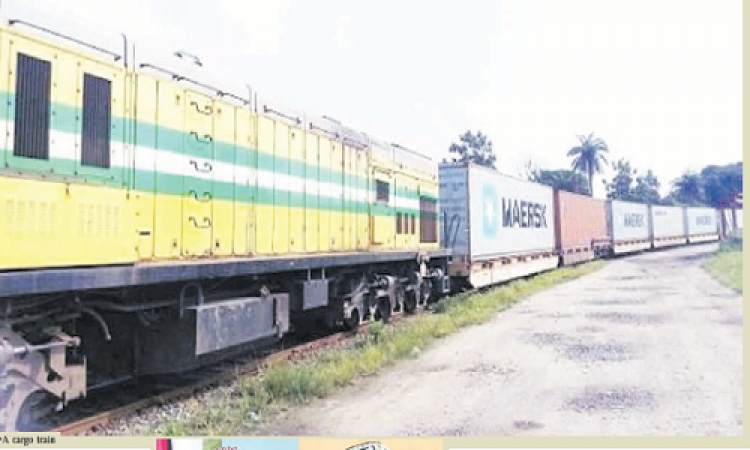
The Federal Government has set the ball rolling to use rail cargo to decongest roads and seaports in the country, a move in line with international best practices.
The case for rail freight as opposed to road transport to decongest seaports, roads seems, on the surface, easy to make.
Rail infrastructure may be more capital intensive to deploy than roads, but its lower maintenance cost and ability to reduce pressure on roads confer superior advantages over the latter.
Again, besides not being affected by road traffic, rail transportation has also proven to be a more economical and energy-efficient means of transit in the long run.
Another bonus the rail system offers is a reduction in terms of the cost of delivery.
This, perhaps, explains why globally, rail transportation is one of the most common modes of mass transit.
For instance, in much of North America, Europe, Russia, China and Eurasia, major cargoes are transported by rail.
Interestingly, however, it is trucking that moves the most tonnage of all traffic in most large economies.
A Wikipedia article ‘Rail freight transport’ says the United States moves 40 per cent of its traffic tonnage by rail freight, Russia 12 per cent, Japan 5 per cent China 8 per cent The European Union less than 20 per cent.
But change is in the air and many countries are moving to increase speed and volume of rail freight so as to relieve overburdened roads and/or speed up shipping in the age of online shopping.
Some nations have even advanced to high-speed trains for both passenger and cargo traffic.
Nigerian rail puzzle
Like in most African countries, the railways were mostly started by colonial powers to bring inland resources to port. There was little regard for eventual interconnection. As a result, there are a variety of gauge and coupler standards in use.
As beneficial as rail transport is, Africa’s biggest economy Nigeria, with a population of about 200 million has a rail system of only 3,505 km.
Its economical rival South Africa with about a quarter of Nigeria’s population has 36,000 kilometres (22,000 mi) of track.
For decades after independence, Nigeria’s rail system virtually ground to a halt, despite billions purportedly spent on the sector, until the administration of former President Goodluck Jonathan began moves to revive the system.
However, the administration of President Muhammadu Buhari is showing the greatest prospects of turning the sector’s fortunes around.
Kaduna Inland Dry Port to Lagos
Recently, news that the federal government has begun cargo delivery service from Kaduna Inland Dry Port to Lagos seaports was met with joy by stakeholders, importers and exporters.
The cargo service is targeted at creating 24,000 direct jobs within and around the dry port and is also expected to reduce the cost of delivery by at least by 50 per cent.
The Nigerian Railway Corporation (NRC) designated 24 flatbed wagons for evacuation and transportation of cargoes from the dry port.
Minister of Transportation Rotimi Amaechi, who spoke during the flag-off ceremony, said the dry port project was part of measures introduced by the federal government to decongest the seaports, as well as place a lesser burden on the roads.
Ameachi, who was represented by the Director of Maritime Services, Sani Galandanci, explained that the service will address the loss of cargo in transit, stop carnage and accidents on the roads, reduce transport cost and bring shipping services closer to shippers which would stimulate economic growth development.
Attracting business from neighbouring countries
Kaduna State Governor Nasir el-Rufai said the cargo service will not only boost the state’s internally generated revenue and decongest the seaports, but also open a new vista of commercial opportunities not only for northern businessmen but even for neighbouring countries.
On the area of availing the opportunity for neighbouring countries, he disclosed his intention to send a trade delegation to Niger Republic with the aim of wooing them to utilise the cargo service..
El-Rufai said: “The commencement has confirmed that our inland dry port is functioning and you can ship your goods direct from Kaduna to any part of the world and you can also import goods from any part of the world direct to Kaduna without your containers or any of your goods being opened up for inspection in Lagos. It has opened a new vista of commercial opportunities not only for Northern businessmen but even for our neighbouring countries.
“The economic benefit of the port cannot be understated. The optimal operations of an inland dry port will impact tremendously on agro business, stimulate industrialisation and production, thereby increasing our internally generated revenue. It will create jobs for our young people, it will expand business opportunities and also lower the cost of doing business for our businessmen here in Nigeria as well as lower the cost of agricultural products in southern Nigeria.”
Importers, exporters to smile
Also speaking, the Executive Secretary of the Nigerian Shippers Council, Hassan Bello said the cargo service will address the challenges faced by the importers and exporters and guarantee seamless movement of cargo from the seaports to Kaduna Inland Dry Port.
Harping on efforts taken to attract investors to Kaduna, he said: “We are in preliminary discussion with Commonwealth Enterprise and Investment Council in London and we want to bring them to Kaduna so that they can have a look so that they will know what value they can add to the dry port.
“It is important that the dry port is not just a transportation centre but a hub of economic activities. We need to have so many facilities, like stores, refrigerated warehouses, consolidation centres, factories especially for packaging which is a problem for export.”
Connecting all seaports by rail
With the success of the rail interconnectivity between Kaduna and Lagos seaports, the president’s directive that all the nation’s seaports be connected by rail for improved evacuation of cargoes to the hinterland is on track.
The government has also concluded arrangements to compensate all the terminal operators that their facilities would be affected in the ongoing efforts to bring back the rail tracks to the Lagos seaports.
The initiative, it was learnt, is to boost quick evacuation of cargoes from the port, enthrone efficiency and boost government revenue.
Nigerian Ports Authority (NPA) Managing Director Ms Hadiza Bala Usman disclosed that the multibillion naira contract for the construction of the rail tracks inside the port has been awarded by the government.
She said that the contractor was engaged by the Federal Ministry of Transportation and the Federal Railway Corporation as part of sustainable efforts of the Federal Government to end the perennial gridlock on Apapa roads.
“I think it is evident that as a Port, you cannot have all your cargoes evacuated by road. Therefore, what we intend to do this year is to deploy the necessary rail connection to the port. As you can see, there is an ongoing work in the Apapa/Tin-Can area by the contractor engaged by the Federal Ministry of Transportation.
“They have demolished some warehouses and they are about to start to lay the tracks for the rail.
“We are keen to have the project concluded and that is why we have identified areas where we would require access to the terminals.
“The Federal Ministry of Transportation has provided the necessary compensation for those locations that are going to be used for the rail tracks,” she said.
The move, the Managing Director said, was part of the new initiative by the government to reduce the perennial gridlock on Apapa roads and boost evacuation of cargoes from the ports.
While assuring the stakeholders that the Apapa/Oshodi/Oworonshoki would soon be completed, Ms Usman said the NPA is excited because “rail is really a cargo means of transportation and that is where the revenue is.”
Sustaining the rail system
The Lagos-Kano Standard Gauge Rail Line (Lagos-Ibadan Standard Gauge) extends to Apapa. The rail project itself holds the key to the connectivity between the commercial city of Lagos in Western Nigeria and the economic centre of Kano in Northern Nigeria.
CCECC Nigeria Limited is building an assembly plant in Kajola, Ogun State to sustain the rail project.
Amaechi said: “It was in furtherance of these objectives that the Federal Ministry of Transportation and Messrs CCECC signed a deed of agreement for the establishment of the plant on March 17, last year to commence the production and assembly of rolling stocks, spare parts and maintenance equipment in Nigeria.
“Consequently, Messrs CCECC conducted a feasibility study in which the choice of Kajola in Ogun State was arrived at as scheduled location for the project.”
He added that the wagon assembly plant was a direct investment of Messrs CCECC Nigeria Limited and seen as part of the gains of the contract signed for the building of the standard gauge in Nigeria.
He added: “This would be the first of its kind in Nigeria, and the first batch of wagons to be used on the completion of this Lagos-Ibadan rail project is expected to be produced from this plant.”
The Managing Director of CCECC Nigeria Limited Mr. Michael Jiang said the corporation decided to invest in an assembly plant in Nigeria to further demonstrate its confidence in the giant strides of the government in developing reliable railway super-structure for the country.
Vice-President Yemi Osinbajo described the plant as an important project for the production of rolling stock, spare part and maintenance equipment needed for the railway modernisation programme being undertaken by the Buhari administration.
He added that when completed, the plant will produce some parts of the wagons for the Lagos-Ibadan and Abuja and Kaduna rail line. It will also be able to satisfy the needs of other rail operators within the West African sub-region and the African Continent.
National Single Window
Amaechi, who believes the rail system will end the gridlock at the Apapa ports, said: “Initially, the rail system was to stop at Ebute Meta. But I said I have never seen a country where the rail system would end in the town; it must get to the seaport. So we awarded a contract to the seaports – Apapa Port, Port Harcourt Port, Warri Port, Calabar Port and Onne Port.”
He said the container-laden articulated vehicles that clog Lagos roads should ordinarily be put on the rail tracks for onward transportation to Ibadan, and from there to other parts of the country. He added that once such cargoes are being transported by rail, the pressure on roads would stop and the roads would be back to normal.
“We’ve awarded the contract from Ibadan to Kano for 5.3 billion dollars. We are looking to get a loan from the Chinese government. If we’re able to get that and we construct the rail from Ibadan to Kano, the problem in Apapa would have been significantly reduced,” Amaechi said.
He said another challenge was the inability of the country to establish a National Single Window, even as he noted that Nigeria has remained the only country in West Africa without such a system in place.
“National Single Window is the synchronisation of the process of clearing of goods,” he explained. “What that means is that, as soon as your goods are on the ship, before the ship gets to Nigeria, all the clearing processes would been completed. In fact, in Benin Republic, if you don’t get your cargoes out in 24 hours, there is a park where they are put, so that the seaport would be empty.
“As soon as your goods arrive, they are cleared immediately. There are tracking systems that would monitor your goods from the port of origin to Nigeria. And there are investors that are ready to put down their money, but government must play its part.”